Understanding Curtain Fullness
Fullness is what turns a flat piece of fabric into a curtain with soft, even folds. Get it right and your curtains hang with proper body; skimp on it and they hang flat and thin. This guide explains how fullness is calculated, how much fabric each heading style needs, and lets you work out your own numbers with the calculator below.
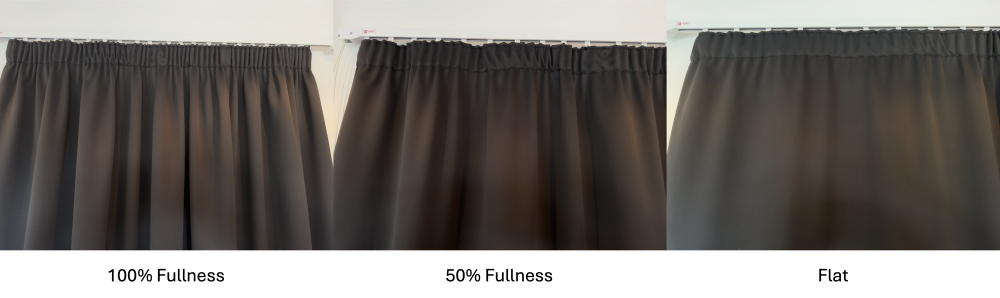
What is curtain fullness?
Curtain fullness is the amount of flat fabric used to cover the width of your curtain track or pole. The more flat fabric you gather onto that width, the more pleats and folds you get once it's hung — and the fuller and richer the curtain looks.
Fullness is a percentage of your track width, not your window width. Track width + fullness % = the total flat fabric you need to make the curtain.
Fabric & fullness calculator
Enter your track or pole width, pick a heading style, and we'll work out how much flat fabric you need — rounded up to the nearest half fabric width, the way we cut every order (a half width can be joined to a full width, so we don't waste a whole extra one).
Enter your track width above and hit calculate to see how much fabric you'll need.
Fullness by heading style
Heading styles are listed in price order — pencil pleat is the most affordable, followed by eyelet, pinch pleat and then wave. For the full breakdown of each style see our Curtain Heading Style Guide.
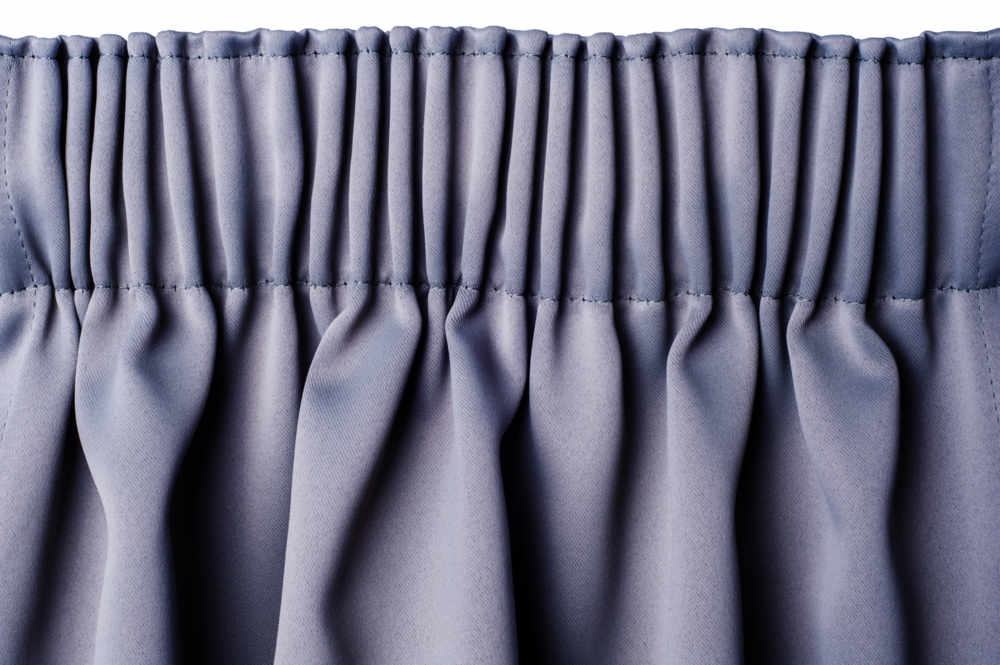
Pencil Pleat
The traditional, most affordable heading. Flexible tape lets you adjust the drop above your track.

Eyelet
A modern finish that shows off your pole. Available in 44mm or 66mm rings.
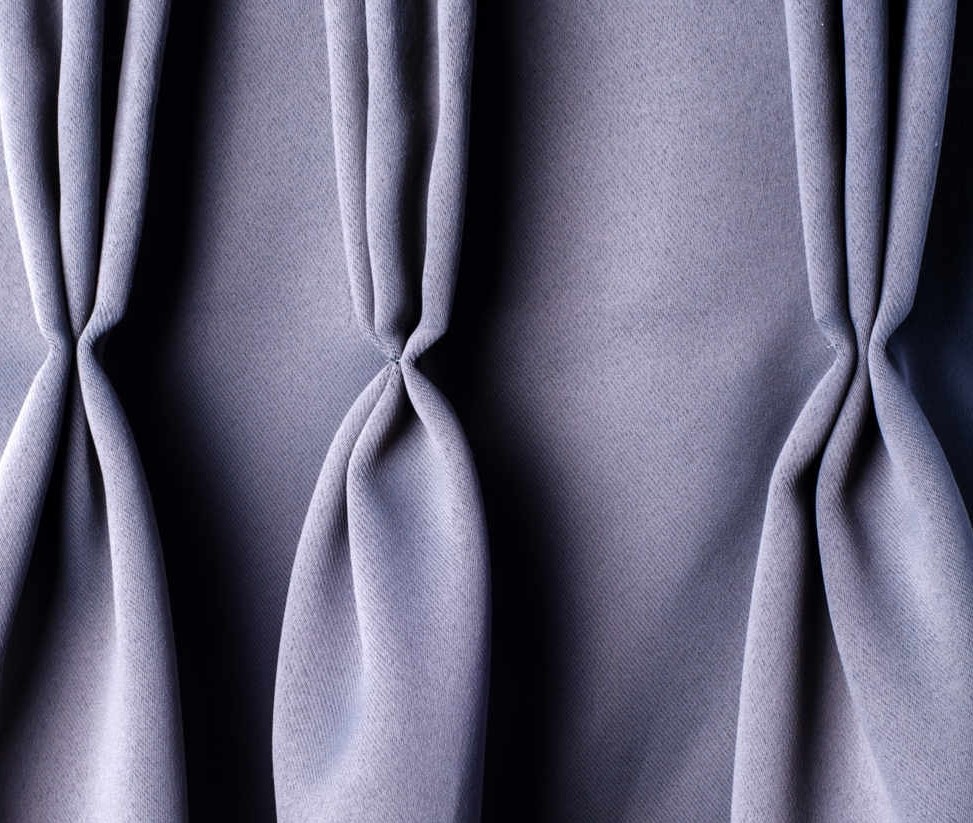
Pinch Pleat
Tailored, sculpted pleats. Gathers tighter than pencil pleat, so it needs more fabric.

Wave
Smooth, continuous folds for a modern, minimalist look. 60mm or 80mm pleat depth.
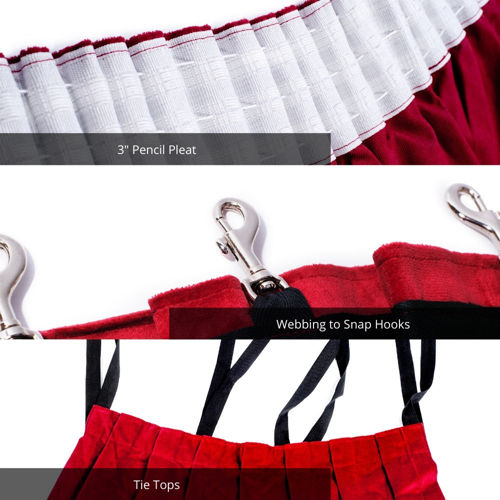
Stage Heading
Heavy-duty pencil pleat for stage & drape use, reduced to fold back more easily.
Quick reference table
| Heading style | Fullness | Flat fabric for a 140cm track | Best for |
|---|---|---|---|
| Pencil Pleat | 100% (2x) | 280cm | Most standard windows |
| Eyelet | 100% (2x) | 280cm | Poles you want on show |
| Pinch Pleat | 150% (2.5x) | 350cm | A tailored, formal look |
| Wave | 120% (2.2x) | 308cm | Contemporary, minimalist rooms |
| Stage / Front of House | 50% (1.5x) | 210cm | Large stage & drape curtains |
Worked example
- Your track measures 200cm and you want a pair of Pencil Pleat curtains at 100% fullness (2x).
- Flat fabric required: 200cm × 2 = 400cm total, or 200cm per curtain.
- Your chosen fabric is 140cm wide, so each curtain needs 200 ÷ 140 = 1.43 widths.
- We round up to the nearest half width — a half width can be joined onto a full width — so each curtain is cut from 1.5 widths, or 3 widths for the pair.
- 3 widths × 140cm = 420cm of flat fabric across the pair, giving a raw cut-fabric fullness of 420 ÷ 200 = 210% — a little fuller than the 100% you asked for.
Rounding to the nearest half width — and why hems matter
Fabric only comes in fixed loom widths, but a half width can be seamed onto a full width, so we round up to the nearest half width per curtain rather than a whole extra width every time. Fabric width still matters: on a 220cm track, a 140cm fabric needs 2 widths per curtain (4 for the pair, 255% fullness), while a 150cm fabric only needs 1.5 widths per curtain (3 for the pair, 205% fullness) — the wider fabric gets you closer to the fullness you asked for, with one fewer join.
These are all raw, flat-fabric figures before making up. Side hems and joining seams take in a few centimetres of every width, so the finished curtain's actual gathered fullness on the track ends up a little less than the raw figure suggests — sometimes only slightly above, or even a touch under, the fullness you originally asked for. Rounding up to the nearest half width is what protects you from falling short.
Special case: stage & drape curtains
Large stage curtains use less fullness — typically 1.5x (50%) rather than 2x. Less fabric means less weight and a slimmer fold-back, so the curtains draw and stack more easily on wide stage tracks.
Our standard fullness
- Eyelet & Pencil Pleat curtains are made to 2x fullness unless you tell us otherwise.
- Front-of-house stage curtains are made to 1.5x fullness.
- We always round up to the nearest half fabric width (a half width can be joined to a full width) to avoid a thin, wasted-looking curtain.
- Side hems and seams take in a little of every width, so finished fullness on the track usually sits slightly below the raw cut-fabric figure.
Frequently asked questions
What is curtain fullness and why does it matter?
It's the amount of extra fabric gathered across your track width. More fullness means more folds and a richer, more luxurious hang; too little fullness leaves curtains looking flat and thin, especially when closed.
How much fabric do I need for 100% fullness?
Double your track width. A 140cm track at 100% fullness (2x) needs 280cm of flat fabric before it's split into a pair and made up.
Why do pinch pleat curtains need more fabric than pencil pleat?
Pinch pleats are stitched into tighter, more defined folds, which uses up more fabric per pleat. That's why we recommend 150% (2.5x) fullness for pinch pleat against 100% (2x) for pencil pleat or eyelet.
What fullness does Direct Fabrics use by default?
Unless you specify otherwise, we make eyelet and pencil pleat curtains to 2x (100%) fullness, and front-of-house stage curtains to 1.5x (50%) fullness.
Can I choose less fullness to save on fabric?
Yes — reducing fullness (for example to 1.5x instead of 2x) uses less fabric and costs less, but the curtain will hang flatter with fewer folds. It's a reasonable trade-off for very wide tracks or budget-conscious orders; just let our team know when you order.
Why do you round fabric widths up instead of down?
Rounding down would leave you short of fabric and a curtain that looks skimped, so we always round up to the nearest half width instead — a half width can be seamed onto a full width, so you're never paying for a whole spare width you didn't need. Remember these are raw, flat-fabric figures before making up: side hems and seams take in a little of each width, so your finished, gathered fullness on the track will typically run a touch below the raw percentage, even after rounding up.
Not sure how much fabric you'll need?
Our team works out fullness, fabric widths and pricing on made-to-measure orders every day. Use the calculator above, or ask us directly and we'll do the sums for you.