


How to Measure for Curtains & Blinds
On this page
Before you start
 Pen and paperFor recording your measurements as you go.
 A helperUseful if your windows are large or your track will be fitted high up.
 Metal tape measureGives a rigid, accurate full-length reading. Cloth ones can stretch.
Start here
Which guide do you need?

Fixing method changes the measurements that matter. Pick the one that matches your window.
Curtain track
Wall-Fixed Track
The most common method, track mounted to the wall above the window.
Read the guide →
Curtain track
Ceiling-Fixed Track
Track mounted to the ceiling, for wall-to-wall runs, bays, and box windows.
Read the guide → Blinds
Recess Fit Blinds
Blind fitted inside the window opening. Give us the recess size, we make the deduction.
Read the guide → Blinds
Exact Fit Blinds
Blind fitted outside the recess, face-fixed to the wall. No deduction, bracket to bracket.
Read the guide → Tracks
Cubicle Track Guide coming soon
Measured wall to wall with right angles, drawn from a plan view of the room. Full illustrated guide in progress.
Quick reference
Where to measure your drop from
The exact starting point for your drop measurement depends on your heading style and what it's fitted to, not just "top of the track" in every case.
| Heading style | Fitted on | Measure from |
|---|---|---|
| Pencil Pleat | Curtain track | Top of the track. On an extra-wide or designer track (e.g. Silent Gliss Metropole), measure from the underside instead. |
| Pencil Pleat | Curtain pole | The small ring underneath the eye, that's where the curtain clips in. |
| Eyelet | Curtain pole only | Top of the pole. We add the upstand allowance for you. |
| Pinch Pleat | Curtain track | The underside of the track. |
| Wave | Track or designer pole | The glider underneath the track, the curtain sits under the track. |
| Acoustic | See heading style above | Same starting point, but go wider and higher, ideally 30cm past each side and 30cm above, and take the curtain to the floor. |
Measure in three places, top of the track, centre, and the other end, and take the shortest reading. Floors and ceilings can run out of level. Double and triple check your measurements before ordering.
Fabric requirement
Curtain fullness explained
Fullness is the amount of flat fabric used to cover your track or pole width. More fabric gathered into the same width means more pleats and a fuller look when closed.
Track width + fullness = total flat fabric
Example: 140cm track + 100% fullness = 280cm of flat fabric
Example: 140cm track + 50% fullness = 210cm of flat fabric
Direct Fabrics uses 2x fullness (100%) for all eyelet and pencil pleat curtains unless stated otherwise, and 1.5x fullness for front-of-house stage curtains, which reduces weight and gathers less tightly so they fold back more easily.
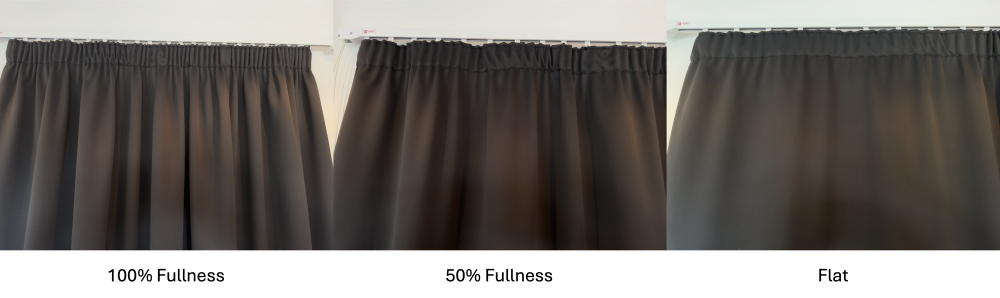
We always round up to the nearest full fabric width to avoid wastage. For example, a 170cm track with pencil pleat curtains at 2x fullness needs 340cm of flat fabric. On a 140cm-wide fabric, that's 2.43 widths, so we'd use 3 full widths for a fuller, better finish rather than cutting it short.
By heading style
Heading styles & fullness
| Heading style | Image | Fullness |
|---|---|---|
| Pencil Pleat (3" or 6") | 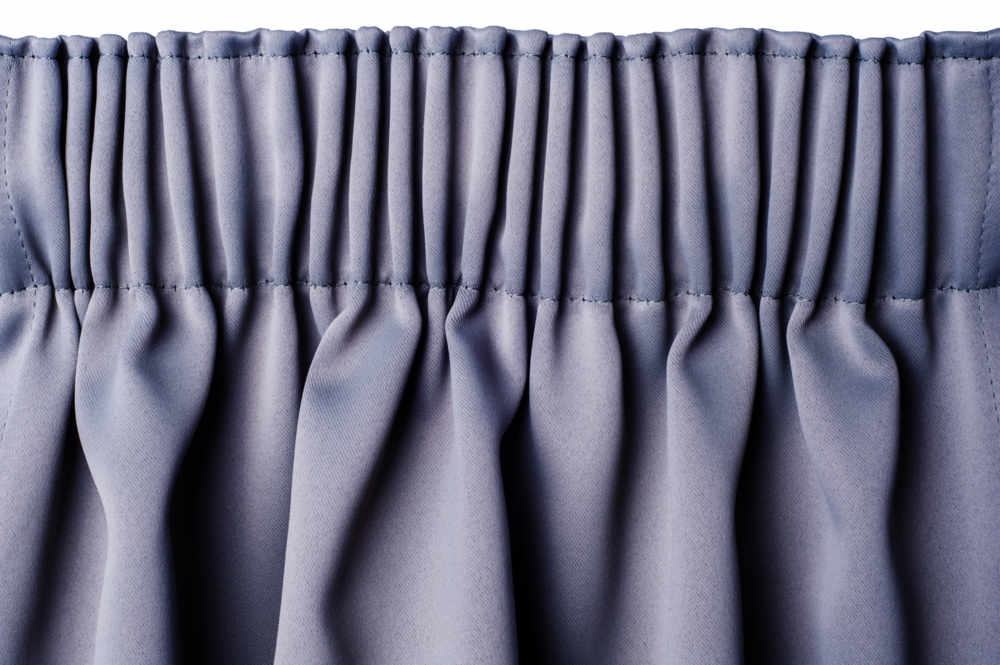 | 2x (100%) |
| Eyelet |  | 2x (100%) |
| Pinch Pleat |  | 2.5x (150%) |
| Wave |  | 2.2x (120%) |
| Stage headings |  | 1.5x to 2x |
Pinch pleat needs more fabric since it gathers tighter into each pleat. Stage curtains typically use less fullness than domestic curtains, to reduce weight and let them fold back more easily.
Space either side of the window
Curtain stacking guide
When curtains are pulled open, they stack back on either side of the window. How much space that takes depends on heading style and fabric thickness, thicker fabrics and tighter gathers stack larger.
| Heading style | Estimated stack | Example on 200cm track |
|---|---|---|
| Eyelet | 15% | 30cm (15cm each side) |
| Pencil Pleat | 25% | 50cm (25cm each side) |
| Pinch Pleat | 35% | 70cm (35cm each side) |
| Wave 80mm | ~18cm/m | Fixed per metre of track, 36cm on a 200cm track |
| Wave 60mm | ~23cm/m | Fixed per metre of track, 46cm on a 200cm track |
These are estimates and can vary with fabric thickness and whether the curtain is lined or interlined.
Keep reading
Other useful curtain guides
 Heading styles
Curtain Heading Guide
Every heading style we offer, side by side.
Read the guide → Fabric requirement
Curtain Fullness Guide
A deeper look at fullness and how it affects the finished look.
Read the guide → Space planning
Curtain Stacking Guide
How much wall space your open curtains will actually need.
Read the guide → Tool
Tool
Curtain Fabric Calculator
Work out exactly how much fabric your order needs.
Use the calculator →Not sure about any of this?
Measuring for the first time, or working with an unusual window, isn't always straightforward. You don't have to get it right alone.
Let us take the measurements
Our team can measure for you before you order, so nothing's left to guess.
Ask about our measuring serviceGet it installed for you
We can arrange installation nationwide, so you don't need to worry about fitting it yourself.
Ask about installation