


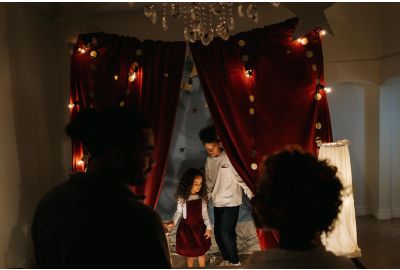
Not every stage curtain has to come with power tools. In fact, many of the venues we work with can’t allow drilling at all. Whether it’s a rented room, a shared space, or a listed building with rules about wall damage, putting up stage backdrop curtains can be tricky without permanent fixings.
Across the UK, we see touring shows, school productions, and community performances using stage backdrop curtains in spaces where setup needs to be simple and reversible. Places like church halls, village centres, and assembly rooms often need quick turnaround times, which means no holes, no permanent fittings, and no damage to walls or ceilings.
That’s why hanging stage backdrop curtains in the UK without drilling is worth planning properly. It’s all about working with the space you’ve got, the way the curtain hangs, and how to keep things safe and tidy at the same time.
Understanding the Space You’re Working With
Before choosing how you’ll hang your curtains, it helps to take a closer look at the space itself. Rooms come in all shapes, and sometimes the design will quietly decide what’s possible.- Low ceilings might make tall backdrops difficult without a freestanding frame
- Old plaster walls or delicate paint finishes often mean no screws allowed
- Ceilings with beams, curved arches, or suspended tiles limit heavier systems
- Temporary pop-up venues and shared-use buildings often need fast removal
Popular No-Drill Curtain Hanging Methods
There are plenty of ways to hang curtains without using a drill. Each method fits best with different setups, and each has its own limits to think about.- Tension poles can help in narrow spaces where there’s something to wedge between
- Freestanding pipe and drape systems are ideal for larger stages or open spaces
- Adhesive hooks or panel clamps can offer short-term options on clean surfaces
Choosing the Right Fabric for a Secure, No-Drill Fit
The curtain type will affect everything from how you hang it to how well it stays put. A thick velvet might feel perfect for drama, but it needs something stronger to hold it up. Lightweight fabrics are a better match for freestanding or no-drill systems. They’re easier to manage, fold smaller, and don’t push so hard on poles or adhesive fixings. Blackout materials or acoustic curtains work nicely and still look professional on stage. They block light behind the performers and can help quieten up a noisy room too. Fabric choice affects:- The load on your support frame or pole
- How much movement the curtain will have when someone walks past
- How it packs and transports between venues
Planning the Setup for Events or Touring Use
When you're taking curtains on the road or setting up again and again, the way you plan makes all the difference. If the curtain doesn’t fit or the pole slips mid-show, it throws everything off. Before we get to assembly, we like to start with solid measurements. Knowing the height, width, and floor space at each venue saves us stress later. Then, we look at how fast it’ll need to set up. Will the same crew manage it each time? Does it pack into a car? A few helpful steps:- Measure your stage space before investing in equipment
- Practice setting up once or twice, so show day goes smoothly
- Store curtain parts in labelled bags or boxes, ready to move
- Choose supports that adjust if you’ll be in different halls each week
When to Consider Professional Help
Sometimes an off-the-shelf option just doesn’t cut it. If your curtain keeps slipping, doesn’t cover the full space, or doesn’t quite look right, it may be worth talking to someone who works with these materials every day. Custom curtain systems are especially helpful in larger venues or places with unusual layouts. A made-to-measure setup accounts for quirks like uneven walls, stage extensions, or unusual ceiling beams. You only have to solve the problem once, and then the curtain can serve you for years. We’ll often suggest professional support when:- The curtain space is wider than standard systems allow
- The venue is busy year-round with lots of different shows
- The stage area includes hard-to-reach corners or changes in height