Free delivery £250 UK ex sh&i + 5 Year Guarantee

Your Basket
Free delivery £250 UK ex sh&i + 5 Year Guarantee
Cart is empty
Top rated
4.9 / 5 on Trustpilot
Subtotal
Delivery:
Free


Loading...
Checkout using your account
Checkout as a new customer
Creating an account has many benefits:
- See order and shipping status
- Track order history
- Check out faster
We are leading suppliers of gable end curtains


4.9
★★★★★
Trustpilot rating
2,306 verified reviews
2,306 verified reviews
60+
Years manufacturing
curtains in the UK
curtains in the UK
100%
Cut to the exact shape
of your window
of your window
5 yr
Guarantee on
all products
all products
Real Installs
A Sloped Window, Properly Dressed
This is a customer's loft room. The window runs up into the roof line, so a standard rectangular curtain would leave the top of the glass bare. Instead, the curtain is cut to the slope, hung on our slimline ceiling track and finished with a 3 inch pencil pleat heading that follows the angle all the way up.
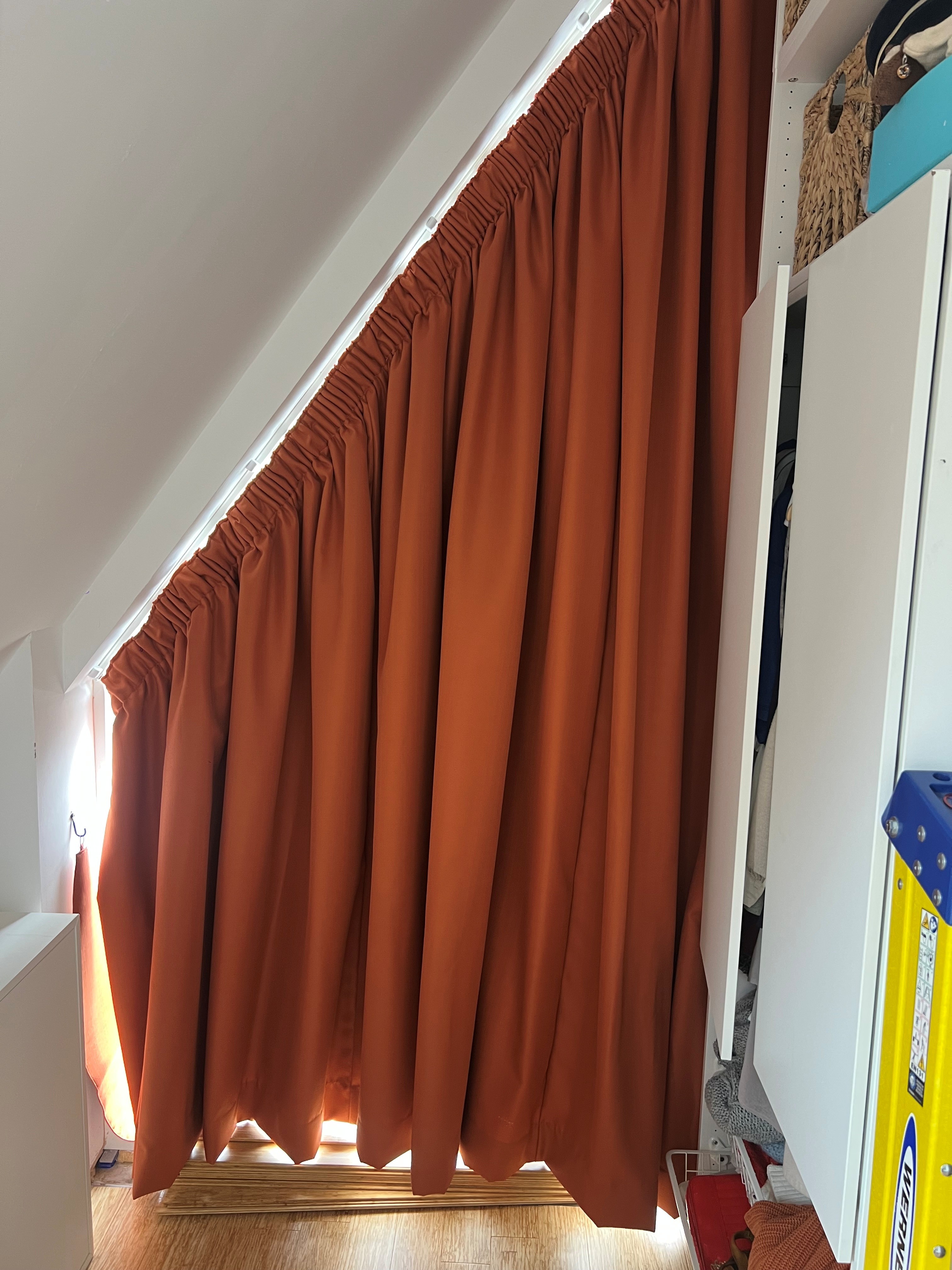
ClosedHeading follows the slope, hem hangs level
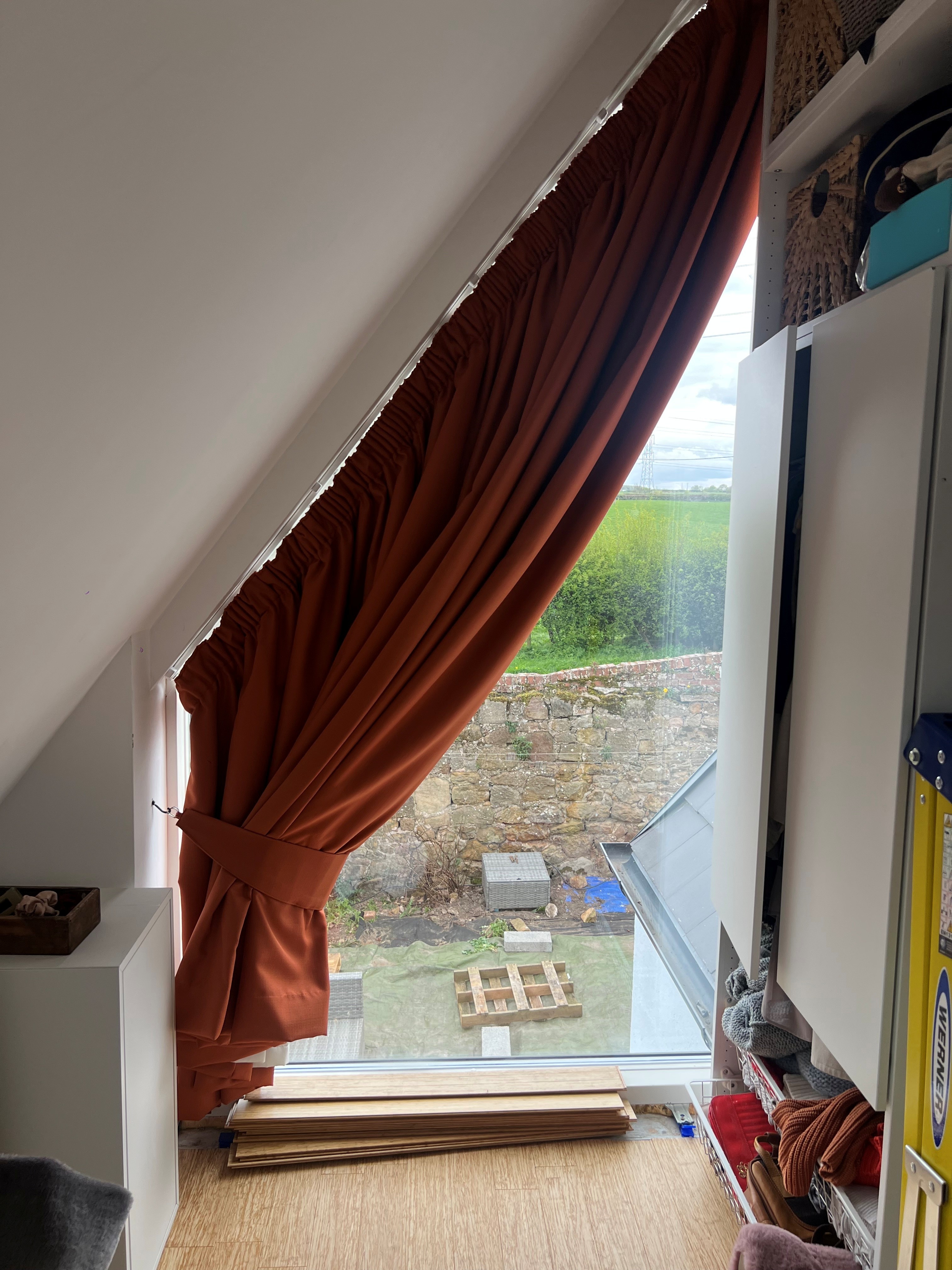
OpenTied back to clear the glass
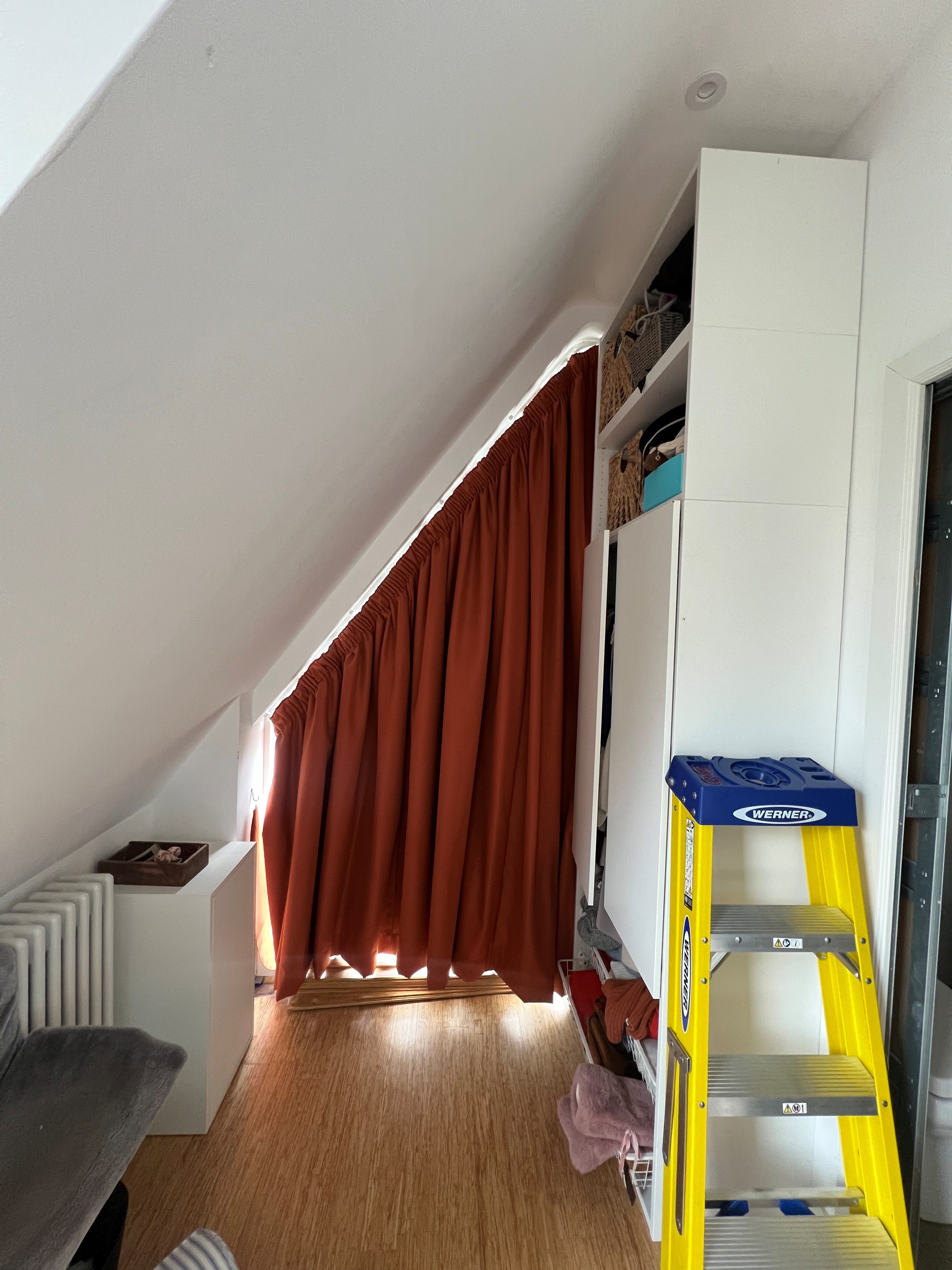
In the roomFull coverage right up to the roof line
How It Works
Why a Shaped Curtain Beats a Standard One
A standard curtain is a rectangle. Hang it under a sloped window and you are left with a triangle of bare glass at the top, which lets in light, heat and cold exactly where you least want it.
A triangular curtain is cut to the angle of your window. The top edge runs along the slope while the hem stays perfectly level with the floor or sill. The result looks deliberate, not improvised, and covers every part of the glass.
The track fixes directly along the slope. We use our slimline ceiling track, which sits close to the surface and keeps a clean line up the rake of the window.
The 3 inch pencil pleat heading gathers evenly along the full length of the track. Because pencil pleat tape is adjustable, the fullness can be fine tuned when you hang the curtain, so the gathers sit evenly from the low end to the high end.
Curtain
Triangular, cut to your angle
Heading
3 inch pencil pleat
Track
Slimline ceiling track
Each curtain is cut so the heading runs up the slope and the hem hangs level.
Your Window
Which Shape Is Your Window?
Gable end and apex windows come in three common layouts. We make curtains for all three. If yours does not match exactly, send us a photo and we will tell you what will work.
Most common in lofts
Single Slope
One side of the window follows the roof line, like the install above. A single triangular curtain on one length of track, usually held open with a tieback at the low end.
Full triangle
Full Apex
The whole window is a triangle. A pair of triangular curtains, one on each slope, meeting towards the centre when closed.
Barn conversions and extensions
Apex With Vertical Sides
A triangle sitting on top of upright sides, the classic gable end. Each curtain has a straight outer edge and a sloped top, so the full window is covered from the sides to the apex.
Measuring
How to Measure an Apex Window
Shaped curtains need a few more measurements than a standard window. Take every measurement in centimetres, measure each side separately even if they look the same, and write them on a photo of the window.
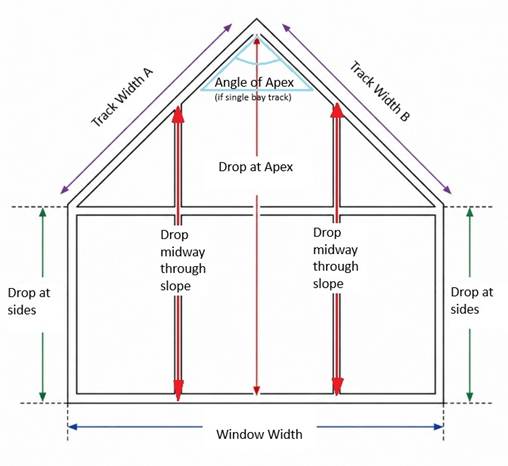
The measurements we need for an apex window
- Track Width A and B. Measure along each slope where the track will be fixed, from the low end to the apex.
- Window width. The full width across the bottom of the window, wall to wall where the curtains will hang.
- Drop at sides. From the bottom of each slope down to where you want the curtain to finish, sill or floor.
- Drop midway through the slope. Halfway along each slope, measure straight down to the same finish point. This lets us check the angle.
- Drop at apex. From the highest point straight down to the finish point.
- Angle of apex. Only needed if you want one continuous track running over the apex rather than a separate track on each slope.

The Easiest Way
Send Us a Photo Like This
One of our customers marked up this photo with every measurement and sent it to us. It is the fastest way to get an accurate quote. Our UK team checks your measurements, confirms the angles and tells you exactly what we will make before anything is cut.
Fitting
Three Things That Make Sloped Curtains Work
Most problems with shaped curtains come from the fitting, not the curtain. Get these three right and the result looks built in.
Fix Into Something Solid
The track runs along a slope, so every bracket carries load at an angle. Fix into timber, rafters or solid masonry wherever possible. In plasterboard, use a fixing rated for the weight of the curtain.
Keep the Track Parallel
Run the track parallel to the window frame along the slope. If the angle of the track drifts from the angle of the frame, the curtain will hang unevenly and the hem will no longer sit level.
Plan Where It Opens To
On a sloped track the curtain naturally gathers towards the low end. Fit a tieback at the low side to hold it neatly open and clear the glass, as in the install photos above.
Honest note on how sloped curtains open
A curtain on a sloped track does not glide open and closed like one on a straight horizontal track. Gravity pulls the fabric towards the low end, so most customers open it by drawing it down the slope and holding it with a tieback. If you need a window to be opened and closed several times a day, call us first and we will talk you through the options for your window.
Why Direct Fabrics
Made for Your Window, Not Adapted to It
Most shops sell rectangles. Gable end windows need something cut and made specifically for them.
✓ Direct Fabrics Shaped Curtains
Cut to your exact angle so the whole window is covered, right up to the apex.
Level hem every time. The top follows the slope, the bottom stays straight.
Track and curtain from one supplier. Slimline ceiling track matched to the curtain, so nothing has to be adapted on site.
Measurements checked by a person. Our UK team reviews your figures and photo before anything is made.
Made in the UK by a manufacturer with over 60 years of experience, backed by a 5 year guarantee.
✗ The Usual Workarounds
Standard curtains below the slope leave a triangle of bare glass at the top, losing heat and letting light in.
A rectangle hung on an angled pole leaves a sloping, uneven hem that never looks finished.
Mixing suppliers for track and curtain leaves you to work out fit and compatibility yourself.
Ordering online with no check means one wrong measurement on an angled window is an expensive mistake.
Leaving it bare means glare, overheating in summer and heat loss in winter in the room that needs it most.
Common Questions
Apex and Gable End Curtain FAQs
Shaped windows raise questions a standard window never does. If yours is not answered here, our UK team is available Monday to Friday, 9am to 5pm.
The quickest way to a firm answer is a photo of your window with the measurements written on it.
Not sure what will work?
Send us a photo and your measurements. We will tell you what we would make and what it will cost.
Can you make curtains for an apex or triangular window?
Yes. We make triangular curtains cut to the exact angle of your window, so the heading follows the slope and the hem hangs level. They are made to measure in the UK for single slope windows, full apex windows and gable ends with vertical sides.
What track do you use for sloped windows?
We use our slimline ceiling track, fixed directly along the slope of the window. It sits close to the surface and keeps a clean line up the rake. For a full apex, you can have a separate track on each slope, or one continuous track running over the apex, in which case we need the angle of the apex.
What heading do triangular curtains have?
A 3 inch pencil pleat heading. Pencil pleat tape gathers evenly along the full length of the sloped track and can be adjusted when hanging, so the fullness sits evenly from the low end to the high end.
Do curtains on a sloped track open and close?
Yes, but not in the same way as a straight track. Gravity pulls the curtain towards the low end of the slope, so it is usually drawn open down the slope and held in place with a tieback. If you need the curtain opened and closed frequently, speak to us before ordering and we will advise on the best option for your window.
How do I measure an apex window for curtains?
We need the length of each slope (Track Width A and B), the window width, the drop at each side, the drop midway through each slope, the drop at the apex and, if you want one continuous track, the angle of the apex. Measure each side separately in centimetres.
The easiest way is to take a photo of the window, write the measurements on it and send it to us. Our team checks everything before the curtains are made.
Can I use any fabric or lining?
Shaped curtains are made from our made to measure range, so you can choose from the same fabrics and lining options, including blackout. Browse the full range on our made to measure curtains page.
Are these suitable for commercial buildings?
Yes. Gable end and apex windows are common in barn conversions, churches, schools and hospitality venues. Flame retardant fabrics are available for commercial projects. See our flame retardant curtains range or contact us for a project quote.
Get Started
Get a Quote for Your Apex Window
Every gable end is different. Send us your measurements or a photo, and our UK team will confirm exactly what we will make, which track you need and what it will cost.
- Triangular curtains cut to your exact angle
- 3 inch pencil pleat heading that follows the slope
- Slimline ceiling track supplied to match
- Measurements checked by our team before we make
- Made in the UK, backed by a 5 year guarantee
Quick Quote or Free Samples
We respond same day during business hours, Monday to Friday. A photo with your measurements gets you the fastest, most accurate quote.
Browse Fabrics

Excellent
Quick Quote & Free Sample Requests
SAVE TIME - Send your project requirements, large or small. Sample Lists etc
100% privacy guaranteed